
A lot of what dermatologists treat is the immune system attacking the wrong target. Psoriasis, vitiligo, alopecia areata, the autoimmune blistering diseases, cutaneous lupus, severe eczema — all are, at root, immune dysregulation showing up in the skin. Our tools for calming that overactivity are often the same broad immunosuppressants used across medicine: methotrexate, ciclosporin, azathioprine, mycophenolate, and the newer biologics. They work, but they work bluntly, and they come with a bill — infection risk, and over the long term, higher cancer risk (something dermatologists see acutely in transplant patients, whose lifelong immunosuppression drives dramatic increases in skin cancer).
So an article summarising a new review in Frontiers in Science caught my eye, because it describes a fundamentally different approach — and one that has just crossed its first real-world milestone.
The problem with immunosuppressants
To manage autoimmune disease or prevent a transplant rejection, many patients accept a lifelong trade-off. Immunosuppressants reduce the immediate threat — the flare, the rejection — but they suppress immunity “relatively indiscriminately,” as Oxford transplantation professor Fadi Issa puts it. That indiscriminate blanket is exactly why they raise the risk of infection and some cancers. You turn down the whole system to quiet one misbehaving part.
What Tregs do differently
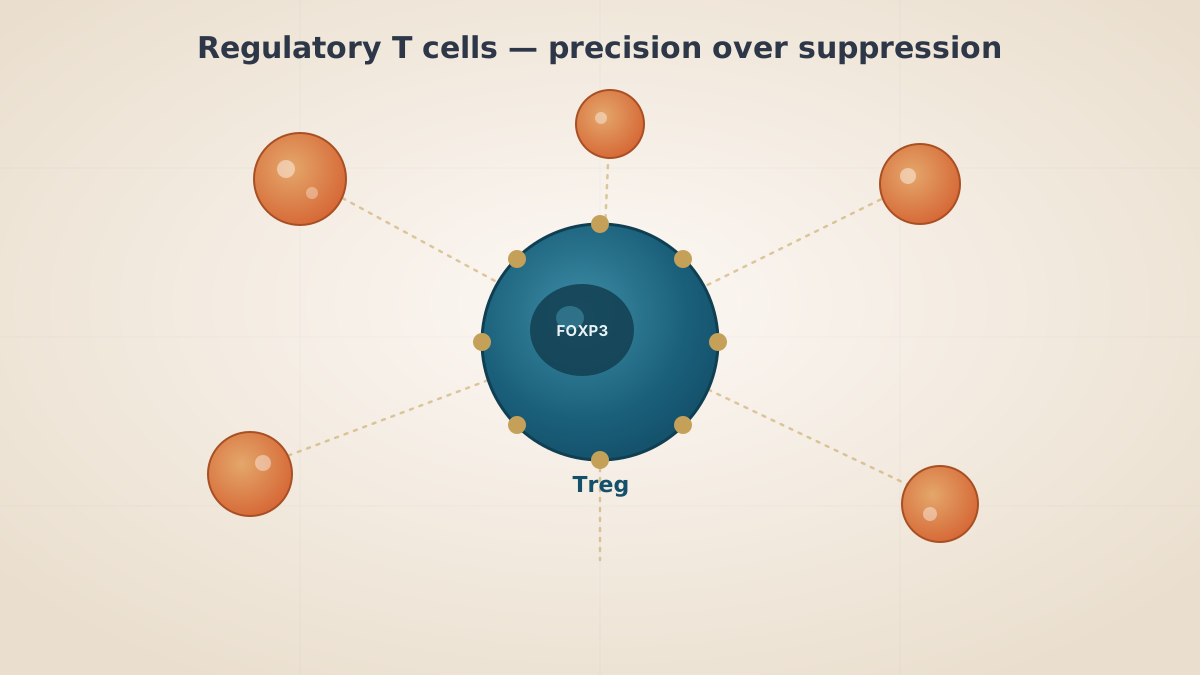
Regulatory T cells (Tregs, said “tee-regs”) are a specialised population of immune cells whose entire evolved job is to prevent the immune system from attacking the body’s own tissues — a property called immune tolerance. When that tolerance fails, autoimmune disease follows. Transplant patients have the opposite problem: their tolerance machinery has to be overcome or it will attack the donor organ.
The appeal, as immunologist Jeffrey Bluestone (a co-author of the review) describes it, is precision. “Tregs do not simply turn off immunity. They actively regulate where, when, and against what immune responses occur.” He compares them to a pharmacy rather than a single drug — they use several tools at once:
- Suppressive signals (cytokines like IL-10 and TGF-beta) that dial down local inflammation.
- CTLA-4, a surface molecule that strips away the “go” signal effector immune cells need to launch an attack.
- Soaking up IL-2, a growth factor that aggressive effector T cells depend on.
- Reshaping local metabolism and even helping repair damaged tissue.
Crucially, most of these mechanisms switch on only in inflamed tissue. That means a Treg is most active exactly where the autoimmune attack is happening — and stays quiet everywhere else. That selectivity is the whole point: precision instead of a system-wide shutdown.
One of the review’s co-authors, Fred Ramsdell, shared a Nobel Prize last year for the discoveries that established how Tregs enforce tolerance in the first place — so this isn’t fringe science.
Why this matters beyond transplantation
Because inflammation drives so many chronic diseases, the potential applications are broad. Tregs are already in human clinical trials for type 1 diabetes, Crohn’s disease, rheumatoid arthritis, transplant rejection, graft-versus-host disease, and ALS, with animal studies pointing to more. Researchers estimate tens of millions of patients across 80-plus autoimmune diseases could eventually benefit, with possible extensions into neurodegeneration, heart disease, and allergy.
There’s even a counterintuitive cancer angle: because tumours hijack Tregs to hide from the immune system, the usual goal has been to remove them — but one proposal is to use Tregs as “Trojan horses” to deliver anti-cancer drugs directly to tumours.
The milestone — and the caveats
The reason this is more than a hopeful review: the first Treg cell therapy has just been cleared by the FDA. Orca-Bio’s product (graft name Tregzi, from the Orca-T programme) is a stem-cell transplant graft enriched with Tregs for blood cancer patients. In its phase 3 trial (Precision-T), it improved survival compared with standard transplants without chronic graft-versus-host disease — the debilitating complication where donor immune cells attack the recipient. That’s a real, approved product, not a press release.
The honest caveats matter, though:
- This is a long-term direction, not next year’s clinic. Issa expects early- and mid-phase trials to expand over the next 5–10 years for most indications.
- Manufacturing is hard. Growing a patient’s own Tregs in a lab and reinfusing them is expensive and has to be repeated per person. The field is pushing toward “off-the-shelf” products from healthy donors, and even toward engineering Tregs directly inside the body.
- We don’t yet fully know why they work for some patients and not others — one of the key questions the next decade of trials has to answer.
What it could mean for skin disease
None of this is prescribable in a dermatology clinic today. But look at the target list — type 1 diabetes, RA, Crohn’s, transplant tolerance — and the overlap with immune-mediated skin disease is obvious. Psoriasis, alopecia areata, vitiligo, and the autoimmune blistering diseases are all conditions where “reset tolerance precisely, without blanket immunosuppression” would be transformative. And for the transplant patients dermatologists already follow closely for skin cancer, a future where their anti-rejection strategy doesn’t itself drive cancer risk would be enormous.
This is early, and the timeline is a decade, not a year. But the underlying idea — retraining the immune system instead of just suppressing it — is one of the more genuinely hopeful directions in medicine right now. Worth watching closely.