
Antibiotic resistance keeps showing up in this blog because it keeps showing up in the clinic. Skin infections that don’t clear, recurrent boils, persistent fungal nails, the occasional stubborn STI — each is a small reminder that our pharmacy is shrinking. New ideas, especially ones that don’t look like the next antibiotic in a familiar family, are worth paying attention to. A University of Alberta team has just put forward one of those ideas.
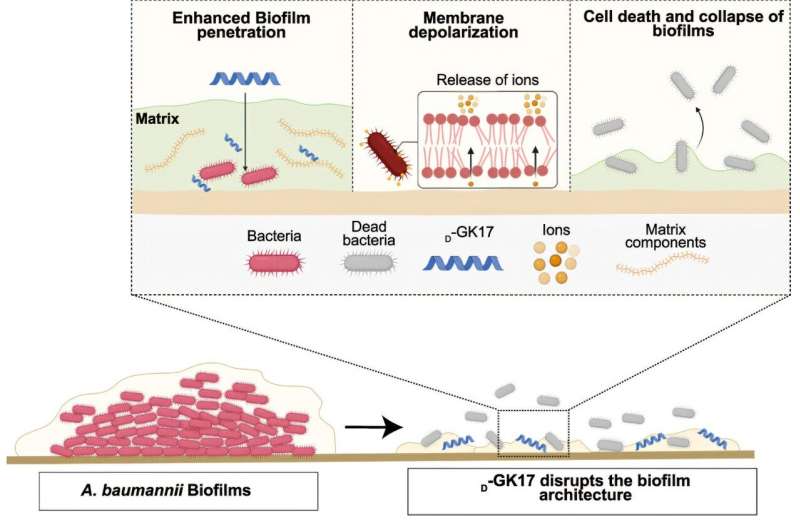
The biofilm problem
Most of what we call “antibiotic failure” in everyday practice is not, strictly, the antibiotic failing to kill bacteria in a Petri dish. It’s the antibiotic failing to reach the bacteria once they’ve set up a biofilm — a sticky polymer scaffold that bacteria build to protect themselves on the surface of a wound, an implant, a chronic ulcer, or the inside of a sinus. Biofilms are estimated to underlie a large share of serious, persistent infections, and they’re a major reason the same antibiotic that worked beautifully in a culture flask sometimes does very little in a real patient.
Conventional antibiotics weren’t designed for biofilms. The team at the University of Alberta — led by researchers in the Faculty of Medicine & Dentistry working with the Li Ka Shing Institute of Virology — set out instead to mimic something our own immune system does, then re-engineer it so it would actually survive in the body long enough to work.
What’s new about D-GK17
Our skin and mucosal cells naturally produce a peptide called LL-37. It’s part of the first line of defence against pathogens: punches holes in microbial membranes, helps recruit immune cells, supports wound healing. The catch — and the reason peptides like LL-37 haven’t translated easily into drugs — is that at the concentrations needed to kill resistant pathogens, the same peptides tend to also damage human cells, or get chewed up by enzymes before they can act.
The Alberta team focused on a short subunit of LL-37 called GK17, then made it as a mirror image of the natural form (the “D-” prefix in the name signals D-amino acids, the geometric inverse of the L-amino acids that make up almost all natural peptides). This trick — flipping the molecule’s handedness — has been used in peptide chemistry for years; it preserves the structural shape that gives the molecule its activity while making it nearly invisible to the body’s proteases. The result, reported in Cell Biomaterials, is a compact peptide that retains its membrane-disrupting activity, remains stable in biological environments, and shows a much more favourable safety margin in the team’s testing.
In their experiments, D-GK17:
- Broke apart biofilms of multiple problem organisms — including members of the ESKAPE group of multi-drug-resistant pathogens (the WHO’s priority list).
- Killed both bacteria and fungi. That cross-kingdom activity matters clinically — patients with mixed wound infections or compromised immunity often have both types of pathogen present.
- Did not kill human cells at the doses that killed the pathogens — the therapeutic window the field has been struggling to find.
- Reduced inflammation and promoted wound healing in skin-infection models, which suggests the peptide isn’t just antimicrobial but is also nudging the host response in a useful direction.
The mechanism, as the authors describe it, is brute-force-but-elegant: the peptide creates pores in microbial membranes, causing cellular contents to leak out. Because that’s a physical disruption rather than a single enzyme target, it’s much harder for microbes to evolve resistance against — which is one of the reasons antimicrobial peptides have long been seen as a promising direction even when the engineering has been tough.
What this might mean for dermatology
Plenty of skin and soft-tissue infections we deal with — recurrent staph carriage, chronic eczema with secondary infection, diabetic foot ulcers, persistent acne with biofilm involvement, post-surgical wound infections — sit in exactly the space where biofilm-targeted antimicrobials would help most. A topical or wound-care application of something like D-GK17, if the engineering and clinical trials hold up, is the kind of intervention that would change real practice, not just academic discussion.
The usual caveats apply: this is early-stage research, not a treatment available to prescribe. The peptide has not entered human trials yet (laboratory and animal models only), formulation and cost are real unsolved problems, and the path from a Cell Biomaterials paper to a topical wound-care product takes years. But the underlying approach — mirror-image peptides that mimic our own host defence molecules — is a serious line of research, and this paper adds a credibly engineered candidate to it. Worth watching.