
Fungal infections have been a recurring subject on this blog, for a simple reason: they’re getting harder to treat. The antifungal drugs we rely on are a small toolkit to begin with, resistance is climbing, and serious Candida infections in hospitalised or immunocompromised patients carry frightening mortality. So a genuinely new mechanism — not another molecule in an existing drug family — is worth paying attention to. A UC San Diego team has just published one.
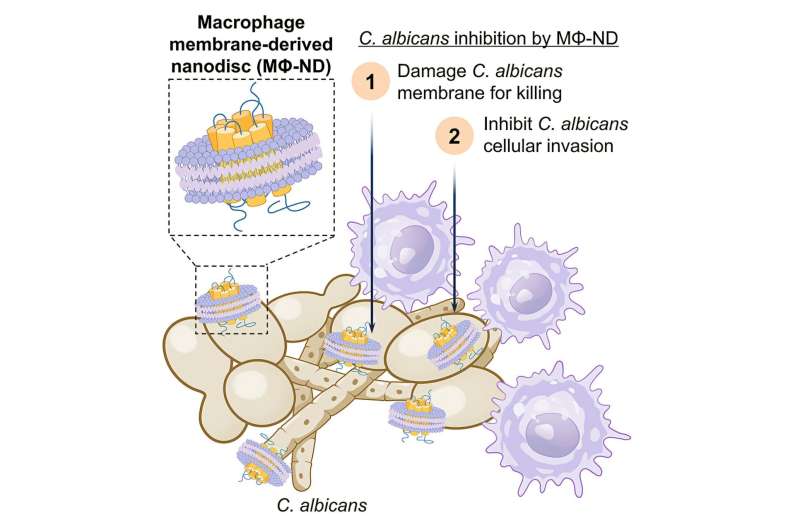
Borrowing an immune cell’s outer coat
The clever idea here is disguise. The researchers took tiny biodegradable polymer particles — nanodiscs, just 10–20 nanometres across (a human hair is roughly 80,000 nm wide, for scale) — and wrapped them in the cell membrane of macrophages, the white blood cells that are one of the body’s front-line fungus hunters.
Because the nanodiscs carry a real macrophage membrane, they also carry that membrane’s recognition proteins — the molecular “hands” a macrophage uses to grab onto pathogens. So the nanodisc inherits the immune cell’s ability to seek out and stick to Candida albicans, the yeast behind most human candidiasis (oral thrush, vaginal yeast infections, and dangerous bloodstream infections).
Three things at once
Once a nanodisc latches onto a fungal cell, the paper describes it doing three useful things simultaneously:
- Physical rupture. The nanodisc disrupts the fungal cell membrane, causing the cell’s contents to leak out — a mechanical kill rather than a chemical one. This matters because physical disruption is much harder for a fungus to evolve resistance against than a drug that targets a single enzyme.
- Immune amplification. Rather than working alone, the nanodiscs boost the body’s own natural antifungal immune response — recruiting and activating the real immune system rather than replacing it.
- Anti-biofilm. They prevent Candida from forming biofilms — the protective sticky matrices that make established fungal infections so stubborn (a theme we’ve covered before with bacterial biofilms).
In mice with systemic Candida infection, the treatment substantially reduced fungal load in vital organs and improved survival in a dose-dependent way — meaning more of the treatment produced more benefit, the pattern you want to see in an effect that’s real rather than incidental.
Why the “membrane-coating” trick is interesting
Cell-membrane-cloaked nanoparticles are a growing field (the same broad strategy has been explored for cancer and for neutralising bacterial toxins). The appeal is that instead of trying to engineer a synthetic molecule that mimics all the complexity of an immune cell’s surface, you just use the real surface — harvest the membrane, wrap it around your particle, and inherit its targeting for free. It’s a neat piece of biological pragmatism.
What this means for dermatology
Nothing prescribable yet — this is mouse-stage research, and the road from a Cell Biomaterials graphical abstract to an approved antifungal is long and littered with candidates that didn’t make it. Systemic delivery, manufacturing at scale, cost, and human safety are all unsolved.
But the clinical target is squarely in our world. Candida is one of the most common fungal pathogens dermatologists deal with — cutaneous candidiasis, intertrigo, chronic mucocutaneous candidiasis, nail involvement, and the recurrent vaginal and oral infections that patients find so frustrating. Resistance among Candida species (especially the emerging Candida auris) is exactly the kind of problem this technology is aimed at. If a topical or targeted formulation of something like this ever reaches the clinic, it would be a meaningful addition to a thin antifungal shelf.
Filing this one firmly under “promising, early, worth watching.”