
Ringworm sounds almost quaint — a common, easily-cured skin infection most people have heard of. For decades that reputation was earned: a scaly ring on the skin, a couple of weeks of an antifungal cream or a short course of pills, done. That is now changing, and the reason is a fungus called Trichophyton indotineae.
A study tracking fungal identifications across dozens of countries found that T. indotineae has now turned up in at least 29 countries, with the number of identifications tripling between 2022 and 2025. This is not a rare curiosity anymore — it’s an emerging global problem, and one that matters more to us than to most, because of where it came from.
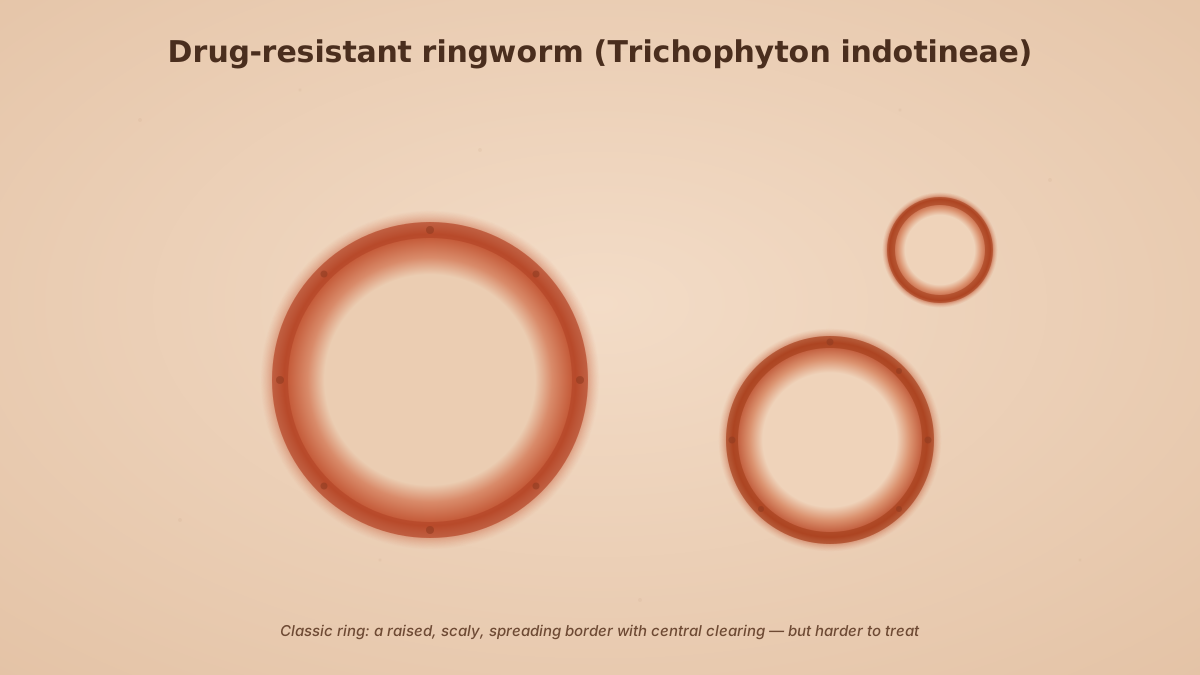
What makes this one different
Ordinary ringworm (medically, tinea) responds well to terbinafine, the standard first-line antifungal tablet, and to topical antifungal creams. T. indotineae often doesn’t. Many isolates are resistant to terbinafine, so the treatment that used to reliably clear ringworm in a few weeks simply stops working.
The result, as doctors have described it, is grim in a low-grade way: extensive, intensely itchy rashes that start in one area — often the groin (tinea cruris) — and spread to cover large parts of the trunk, limbs, and beyond. Patients try cream after cream, get partial relief at best, and the rash keeps coming back. Because it’s so often misdiagnosed or under-treated, the delay from first symptoms to correct diagnosis has ranged from 3 months to over 3 years in reported cases.
Why our region is squarely in the picture
T. indotineae emerged from South Asia — India, Bangladesh, and neighbouring countries — where it is now extremely common. In the case series that alerted Western doctors, most patients had recently travelled to the region, and several caught it through household contact at home.
Malaysia is not far away, and our connections to South Asia — travel, work, family, migration — are deep and constant. It would be naïve to assume this fungus respects borders. If anything, we are closer to the source than the US and Europe, where it’s already a recognised emerging threat. Dermatologists across Asia are already seeing terbinafine-resistant tinea, and it is reasonable to expect more of it here.
The one mistake that makes it dramatically worse
Here is the most useful thing in this whole post, and please take it seriously: over-the-counter steroid-containing combination creams are a major driver of this problem.
You know the ones — the popular tubes sold cheaply at pharmacies and sundry shops that combine a strong steroid with an antifungal (and often an antibiotic too). They’re marketed for “all kinds of skin problems.” When you put a strong steroid on a fungal rash, it does something seductive and dangerous: it calms the itch and redness fast, so it feels like it’s working — while actually suppressing your skin’s immune defence and letting the fungus grow deeper and wider. Used repeatedly, across whole populations, these creams are believed to be one of the main reasons resistant strains like T. indotineae arose and spread in the first place.
So: do not treat a persistent, spreading, itchy rash with a random combination steroid cream from the pharmacy shelf. It may feel better for a few days and be quietly getting worse.
What to actually do
- See a doctor for a proper diagnosis. A rash that looks like ringworm isn’t always ringworm — and if it is, we can confirm it (sometimes with a skin scraping, culture, or other testing) and identify whether it’s behaving like a resistant strain.
- Don’t self-treat with steroid or combination creams. If anything, they muddy the picture and can make a resistant fungus worse.
- Expect that resistant cases need different, longer treatment. T. indotineae often responds to itraconazole rather than terbinafine, but courses are longer and need proper medical supervision — this is not a self-medication situation.
- Treat the household, not just the patient. Because it spreads through close and household contact, family members with rashes should be checked and treated together, or it just bounces back.
- Basic hygiene still matters. Don’t share towels, bedding, or clothing during an active infection; wash them hot; keep skin dry (fungi love warm, moist folds — relevant in our climate).
The bigger picture
Regular readers of this blog will notice a thread: we keep writing about antifungal resistance, and about the thin pipeline of new antifungal drugs. Resistant ringworm is that abstract problem made concrete and itchy and personal. The encouraging side is that genuinely new antifungals are in development (we wrote recently about olorofim, a new drug class for tough cases). The practical side, for right now, is simpler: if a ringworm rash isn’t clearing, don’t keep reaching for stronger creams — come and get it properly diagnosed. Catching a resistant infection early, and treating it correctly, is far easier than untangling one that’s been smeared with steroid cream for a year.