
Aesthetic dermatology has always been, at its heart, about the visible signs of skin aging — fine lines, loss of firmness, dullness, uneven tone. We treat those signs with lasers, peels, injectables, and good skincare. But a deeper question sits underneath all of it: what if you could turn back the age of the skin cells themselves? A National Geographic feature by D.T. Max lays out the science that’s edging toward exactly that — and 2026 marked a genuine milestone.
What “cellular reprogramming” actually means
In 2006, the Japanese scientist Shinya Yamanaka showed that four specific proteins — now called Yamanaka factors — could take a fully mature, specialised cell and wind it all the way back to a stem-cell-like state. It won him a Nobel Prize, and it upended a long-held assumption that a cell’s developmental journey only runs one way.
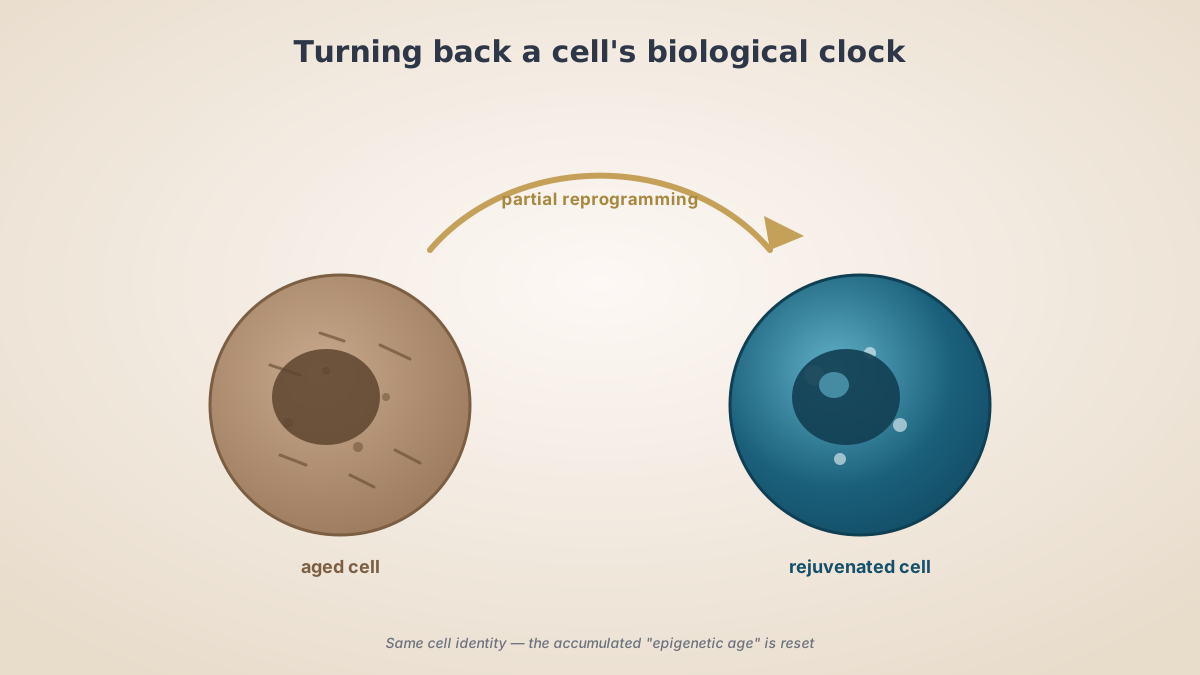
The newer, more subtle idea is partial reprogramming: applying those factors briefly, just enough to reset a cell’s biological “age” without erasing its identity. The insight is that much of aging isn’t damage to your genes themselves — it’s the accumulation of epigenetic marks over a lifetime: chemical instructions layered on top of DNA that gradually get noisier and less accurate, like a much-photocopied document. Partial reprogramming appears to wipe some of that noise clean, letting an old cell behave like a younger version of itself — same cell type, reset clock.
The 2026 milestone
The article’s headline development: in April 2026, Harvard’s David Sinclair and colleagues injected a gene therapy called ER-100 into the eye of a glaucoma patient — the first human trial of cellular reprogramming. The aim was to coax damaged optic nerve cells back toward a healthier, earlier state and restore lost vision. In earlier mouse experiments, Sinclair’s team had repaired vision using the same reprogramming approach. Crucially, they’d made it safer by removing one of the original four factors — a growth-promoting one that carried cancer risk.
Sinclair isn’t alone. The field is now crowded with serious money and serious names:
- Juan Carlos Izpisua Belmonte, formerly at the Salk Institute, now heads Altos Labs — a startup that launched with roughly $3 billion in funding. His progeria (premature-aging) mice lived about 30% longer after reprogramming treatment.
- Startups like Retro Biosciences (backed by Sam Altman), NewLimit (Coinbase’s Brian Armstrong), and Life Biosciences (licensing Sinclair’s work) are all pursuing versions of the same idea.
Belmonte has even proposed a unifying theory of aging he calls “mesenchymal drift” — the idea that many cell types gradually and wrongly convert into fibroblast-like cells, degrading tissue function across dozens of age-related diseases. If reprogramming can reverse that drift, the implications would stretch far beyond any single organ.
The honest part — where the hype outruns the science
Here’s where a dermatology clinic has to be a careful voice rather than an excited one.
- This is early. One human patient, in the eye, in 2026. “First human trial” is a real milestone, not a treatment you can book.
- The biggest fear is cancer. The same process that makes a cell younger and more capable of dividing is, in the wrong dose or the wrong place, exactly what a tumour needs. Every serious lab in this field spends most of its effort on control and safety, not on going faster. Skeptics quoted in the article worry precisely about uncontrolled rejuvenation.
- Whole-body age reversal is not on the table. Resetting cells in a contained space (an eye) is very different from safely rejuvenating every tissue in a living human at once. Whether one treatment could ever do that is genuinely unknown.
What it means for your skin — today and tomorrow
Today: none of this is available as a skin treatment, and anyone selling you “Yamanaka factor” creams or “cellular reprogramming facials” is selling marketing, not medicine. Topical products cannot deliver gene therapy into your cells, and the real science isn’t anywhere near a jar on a shelf.
What actually works today for skin aging is unglamorous but real: daily sunscreen (by far the most powerful anti-aging intervention there is), retinoids, treating pigmentation, and evidence-based procedures — lasers, energy devices, and injectables — matched to your skin and done properly. That’s the foundation, and it isn’t going anywhere.
Tomorrow: skin is, in some ways, an ideal early target for reprogramming science — it’s accessible, you can see and biopsy it, and problems are visible before they’re dangerous. It’s plausible that some of the first real-world cosmetic and reconstructive applications of this technology, years down the line, will involve skin. When that day comes — safely, with evidence, and through proper regulatory channels — it would be one of the most significant shifts aesthetic medicine has ever seen.
For now: be excited about the science, be skeptical of anyone monetising it prematurely, and keep wearing your sunscreen. The most futuristic thing you can do for your skin today is still the most basic one.